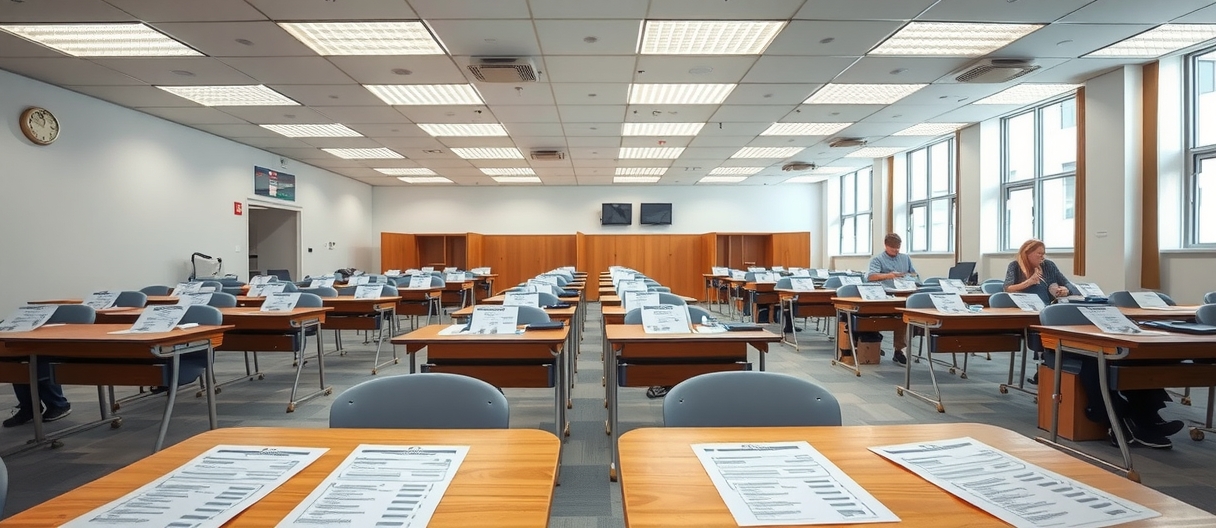
The IELTS Listening test is identical in the Academic and General Training versions. It takes about 30 minutes, contains four recorded parts and 40 questions, and every recording is played once only. This guide sets out the verified 2026 format and the tips that actually move your band score.
- The IELTS Listening test still has four parts, 40 questions and roughly 30 minutes of audio played once only
- The extra 10 minutes to transfer answers applies to IELTS on paper only, because computer test takers type answers directly
- IELTS One Skill Retake lets computer-based test takers resit a single skill within 60 days at selected centres
- A raw score of 32 out of 40 converts to band 7.5.
What Is the IELTS Listening Test Format in 2026?
The IELTS Listening test lasts about 30 minutes and has four parts with ten questions each, giving 40 questions in total. Parts 1 and 3 are conversations, while parts 2 and 4 are monologues. On paper you get an extra 10 minutes to transfer answers.
Parts 1 and 2 are set in everyday social situations. Part 1 is a conversation between two speakers, for example about travel arrangements, and Part 2 is a single speaker, for example a talk about local facilities. Parts 3 and 4 move into educational and training contexts. Part 3 is a conversation between two main speakers, such as two students discussing an assignment, sometimes guided by a tutor. Part 4 is one speaker presenting an academic subject.
A range of native-speaker accents is used, including British, Australian, New Zealand and North American varieties. The questions follow the same order as the information in the recording, so the answer to question one always comes before the answer to question two.
- Duration: approximately 30 minutes of audio, plus 10 minutes transfer time for IELTS on paper only.
- Questions: 40 in total, 10 in each of the four parts, one mark per correct answer.
- Recordings: played once only, with time built in to read the questions beforehand.
- Same test for Academic and General Training candidates.
- Spelling and grammar are marked, so a correct idea written incorrectly loses the mark.
How Can You Improve Your IELTS Listening Band Score?
Improving your IELTS Listening band comes down to daily active listening across British, Australian, New Zealand and North American accents, underlining keywords before each recording plays, writing short notes rather than sentences, checking spelling carefully, and moving on quickly whenever a single question starts costing you time.
Because the audio is played once only, preparation is mostly about attention and prediction rather than raw vocabulary. The following habits are the ones that reliably raise a band.
- Become an active listener. Podcasts, documentaries and recorded lectures build the vocabulary and accent range the test uses. Move to academic material once ordinary speech feels comfortable.
- Underline keywords in the questions during the reading time and predict what kind of answer is needed, such as a number, a date, a place or a name.
- Do not fall for distractors. Speakers often mention an option and then correct themselves, so listen for the final version of the information.
- Hold your concentration for the full 30 minutes. There is no replay, so a lapse of a few seconds can cost several marks.
- Take notes in fragments, not full sentences. You only need enough to recall the answer when you write it down.
- Learn how English letters are spoken aloud for spelling questions, for example that W is said as double-u.
- If a question defeats you, leave it and continue. Chasing one answer usually costs you the next two.
- Check spelling and singular or plural forms before time runs out, and stay inside the stated word limit.
Which Question Types Appear in IELTS Listening?
IELTS Listening uses six official question types: multiple choice, matching, plan, map or diagram labelling, form, note, table, flow-chart or summary completion, sentence completion, and short-answer questions. Answers follow the order of the recording, and marks are lost for incorrect spelling or grammar.
- Multiple choice: you choose one correct answer from three options, either completing a question or finishing a sentence stem.
- Matching: you match a numbered list of items from the recording to a set of options on the question paper, which tests how well you follow a conversation.
- Plan, map or diagram labelling: you label a visual, so you need the language of direction and location such as opposite, turn left or straight on.
- Form, note, table, flow-chart or summary completion: you fill gaps in an outline of the recording, always respecting the stated word limit.
- Sentence completion: you complete sentences with key information, which tests understanding of relationships such as cause and effect.
- Short-answer questions: you write brief factual answers such as places, prices or times, again within the word limit.
How Many Correct Answers Do You Need for Each Band?
Each correct answer scores one mark out of 40, and there is no penalty for wrong answers. Roughly 23 correct answers give band 6, 30 give band 7, 32 give band 7.5, 35 give band 8, and 39 give band 9 in Listening.
| Correct Answers out of 40 (2026) | IELTS Listening Band Score |
|---|---|
| 39-40 | 9.0 |
| 37-38 | 8.5 |
| 35-36 | 8.0 |
| 32-34 | 7.5 |
| 30-31 | 7.0 |
| 26-29 | 6.5 |
| 23-25 | 6.0 |
| 18-22 | 5.5 |
| 16-17 | 5.0 |
Band scores are reported in whole and half bands, and the same conversion applies to both Academic and General Training. Since there is no negative marking, always write an answer even when you are unsure. Most universities set a minimum for each component as well as an overall score, so a weak Listening band can block an offer on its own.
If Listening is the only skill holding your result back, IELTS One Skill Retake allows candidates who sat the full test on computer to resit a single skill within 60 days of the original test, at selected centres. IELTS results remain valid for two years.
Best Universities Accepting IELTS ScoreRead →How Do You Improve Reading, Writing and Speaking Scores?
Reading also lasts 60 minutes with 40 questions, Writing gives you 60 minutes in total for both tasks, and Speaking runs 11 to 14 minutes. Write at least 150 words for Writing Task 1 and at least 250 words for Task 2 to avoid a length penalty.
How to improve your IELTS Reading score
- Practise skimming and scanning against the clock. Academic Reading gives you three long texts and 40 questions in 60 minutes, with no extra transfer time.
- Read widely from newspapers, journals and books, since Academic Reading texts are taken from exactly those sources.
- Work on grammar and paraphrase recognition, because the questions rarely use the same wording as the passage.
How to improve your IELTS Writing score
Writing is assessed on four criteria: task achievement, coherence and cohesion, lexical resource, and grammatical range and accuracy. You have 60 minutes for both tasks together, so plan roughly 20 minutes for Task 1 and 40 minutes for Task 2.
- Respect the minimum lengths of 150 words for Task 1 and 250 words for Task 2. Writing under the minimum is penalised.
- Spend the first few minutes planning so your paragraphs follow a logical order and use clear linking devices.
- Leave time at the end to check tenses, articles and subject-verb agreement, which is where most avoidable marks are lost.
How to improve your IELTS Speaking score
- Treat the interview as semi-formal. Natural English is expected, but avoid slang and text-message abbreviations.
- Extend every answer with a reason or an example. Fluency and coherence is one of the four assessment criteria, so one-word answers cap your band.
- Speak at your normal pace. Rushing creates errors and does not improve your fluency score, while clear pronunciation does.